- Main Article: The Final Handshake: Your Definitive 2025 Guide to the Title Deed Transfer at Thailand’s Land Office
- Related articles:
- Closing from Afar: A Foreigner’s Guide to Using Power of Attorney for Thai Property Transfers
- The Essential Paper Trail: Your Ultimate Document Checklist for Transferring Property in Thailand
- Decoding the Bill: A Complete Cost & Tax Breakdown for Property Transfers in Thailand (2025/2026) (current article)
How much are property transfer fees in Thailand?
Quick Answer: The total government cost for a property transfer in Thailand typically ranges from 2.5% to over 6.3% of the property's official appraised value. This is composed of a 2% Transfer Fee, either a 3.3% Specific Business Tax or a 0.5% Stamp Duty, and a variable Withholding Tax paid by the seller.
Here is a breakdown of the key taxes, fees, and rules for property transfers in Thailand:
- Total Cost: Expect to pay between 2.5% to over 6.3% of the property's appraised value in government fees and taxes.
- The Four Core Costs: The final bill consists of a 2% Transfer Fee, Withholding Tax, and either a 3.3% Specific Business Tax (SBT) or a 0.5% Stamp Duty.
- Who Pays What: The 2% Transfer Fee is typically split 50/50 between the buyer and seller, but this is negotiable. The seller is legally responsible for paying the SBT or Stamp Duty and the Withholding Tax.
- SBT vs. Stamp Duty: The higher 3.3% SBT applies if the seller has owned the property for less than five years. The lower 0.5% Stamp Duty applies if owned for five years or more.
- Foreign Buyer Ineligibility: Government stimulus measures that reduce transfer fees to 0.01% are not applicable to foreign buyers, who must budget for the standard rates.

The true cost of your keys: navigating Thailand’s property transfer fees
When foreign buyers finally reach the Land Office in Thailand to complete their property purchase, many experience an unwelcome surprise: the final bill significantly exceeds the property’s purchase price. The additional costs—comprising various government taxes and fees—can add 2.5% to over 6% to the total transaction value, representing tens or hundreds of thousands of baht in unexpected expenses.
This comprehensive guide provides the definitive breakdown of all government taxes and fees for property transfers in Thailand during 2025/2026, empowering buyers and sellers with the financial clarity needed to budget accurately and negotiate effectively. The confusion surrounding Thai property transfer costs stems largely from the complex interplay of various taxes, their calculation methods, and the often-unclear question of who bears responsibility for each payment.
Understanding these costs is crucial for any property transaction in Thailand. This post focuses specifically on the costs of the transfer process. For a complete walkthrough of the process itself, from document preparation to the final signature at the Land Office, readers should refer to our comprehensive procedural guide.

On this page: Before the transfer day: your definitive pre-transfer master checklist Show more The buyer's essential documents The seller's required documents Property-specific documentation: condo vs. land Deep dive into the paperwork: your cluster resource Decoding the final bill: a complete breakdown of transfer fees and taxes Show more The core government transfer fee Seller's […]
The core four: deconstructing Thailand’s property transfer costs

Thailand’s property transfer system involves four primary government charges that comprise the final bill at the Land Office: the Transfer Fee, Specific Business Tax (SBT) or Stamp Duty (never both), and Withholding Tax. Each serves a distinct purpose within the Thai tax framework and applies under specific conditions.
A critical concept underpins all calculations: every tax and fee is calculated based on either the official appraised value from the Treasury Department or the declared purchase price, whichever is higher. This mechanism prevents under-declaration of sale prices to evade tax obligations—a practice that would otherwise undermine the government’s revenue collection and create an unfair advantage for those willing to engage in questionable reporting.
The appraised value, determined by government assessors, reflects current market conditions and comparable sales in the area. In many cases, particularly for luxury properties or in rapidly appreciating markets like Koh Samui, this appraised value may actually exceed the agreed purchase price, resulting in higher-than-expected transfer costs.
Transfer fee (2%): a shared responsibility
What is the transfer fee?
The transfer fee represents a 2% charge on the property’s assessed value, paid directly to the Land Office for processing the ownership change. This administrative fee covers the cost of updating the title deed (Chanote) and maintaining Thailand’s comprehensive land registration system.
The art of negotiation: who really pays?
While Thai law does not mandate how the transfer fee should be divided between parties, common practice has evolved whereby the buyer and seller split this fee equally—each paying 1% of the property’s assessed value. However, this division is entirely negotiable and should be clearly stipulated in the Sale and Purchase Agreement.
The negotiation often depends on market conditions, the property’s desirability, and the relative bargaining power of each party. In a seller’s market, buyers may find themselves responsible for the entire 2% fee, while in a buyer’s market, sellers might absorb the full cost to close the deal.
Expert Insight: From our experience representing international property transactions, clearly stipulating the division of the transfer fee in the Sale and Purchase Agreement prevents costly disputes on the transfer date. A standard clause would read: “The Transfer Fee shall be borne equally by the Buyer and the Seller.” This specificity eliminates ambiguity and ensures both parties budget appropriately.
Specific business tax (sbt) vs. stamp duty: a critical distinction

Specific business tax (sbt) (3.3%) explained
Specific Business Tax represents a 3.3% levy (comprising 3% SBT plus a 10% local tax surcharge on that amount) imposed on sellers deemed to be conducting commercial property transactions. The primary trigger for SBT liability is ownership of the property for less than five years, as this suggests speculative or business-oriented activity rather than long-term investment.
When SBT applies, it supersedes Stamp Duty entirely—the two taxes are mutually exclusive. The official Specific Business Tax guidelines from the Thai Revenue Department provide the authoritative framework for determining liability.
Stamp duty (0.5%) explained
Stamp Duty, set at 0.5% of the property’s assessed value, applies when SBT is not applicable. The primary condition triggering Stamp Duty instead of SBT is seller ownership of the property for five years or more, indicating long-term investment rather than speculative trading.
This lower rate reflects the government’s policy of encouraging long-term property investment over short-term speculation. The Stamp Duty rules from the Revenue Department outline the complete framework governing this tax.
Key exemptions from sbt
Several important exemptions can relieve sellers from SBT liability even when holding property for less than five years. The most significant exemption applies when the seller’s name appears in the house registration book (Tabien Baan) for at least one year, demonstrating genuine residence rather than speculation.
Inherited properties also qualify for SBT exemption regardless of the inheritance timing, recognizing that inheritance recipients should not be penalized with higher tax rates for circumstances beyond their control. These exemptions require proper documentation during the transfer process.
Withholding tax: the seller’s obligation
Understanding withholding tax (wht)
Withholding Tax is not an additional tax burden but rather an advance payment on the seller’s personal income tax liability arising from capital gains on the property sale. The Land Office collects this amount on behalf of the Revenue Department, ensuring compliance with Thai tax obligations.
The seller can subsequently claim credit for this withholding tax when filing their annual personal income tax return, potentially receiving a refund if the withheld amount exceeds their actual tax liability.
How wht is calculated for individuals
The calculation process involves multiple steps designed to determine fair taxation based on the property’s appreciation and the seller’s holding period. First, a deductible expense percentage is applied based on ownership duration—longer ownership periods allow higher deductions, recognizing inflation and carrying costs over time.
Next, the remaining taxable amount is divided by the number of years owned to calculate an average annual income figure. Progressive personal income tax rates are then applied to this annual amount, and the resulting tax is multiplied by the years of ownership to determine the final withholding tax.
This complex methodology, detailed in the Thai Revenue Code on withholding tax, ensures that sellers with longer holding periods benefit from both higher deductions and potentially lower effective tax rates.
The 2025/2026 government stimulus: what foreign buyers must know
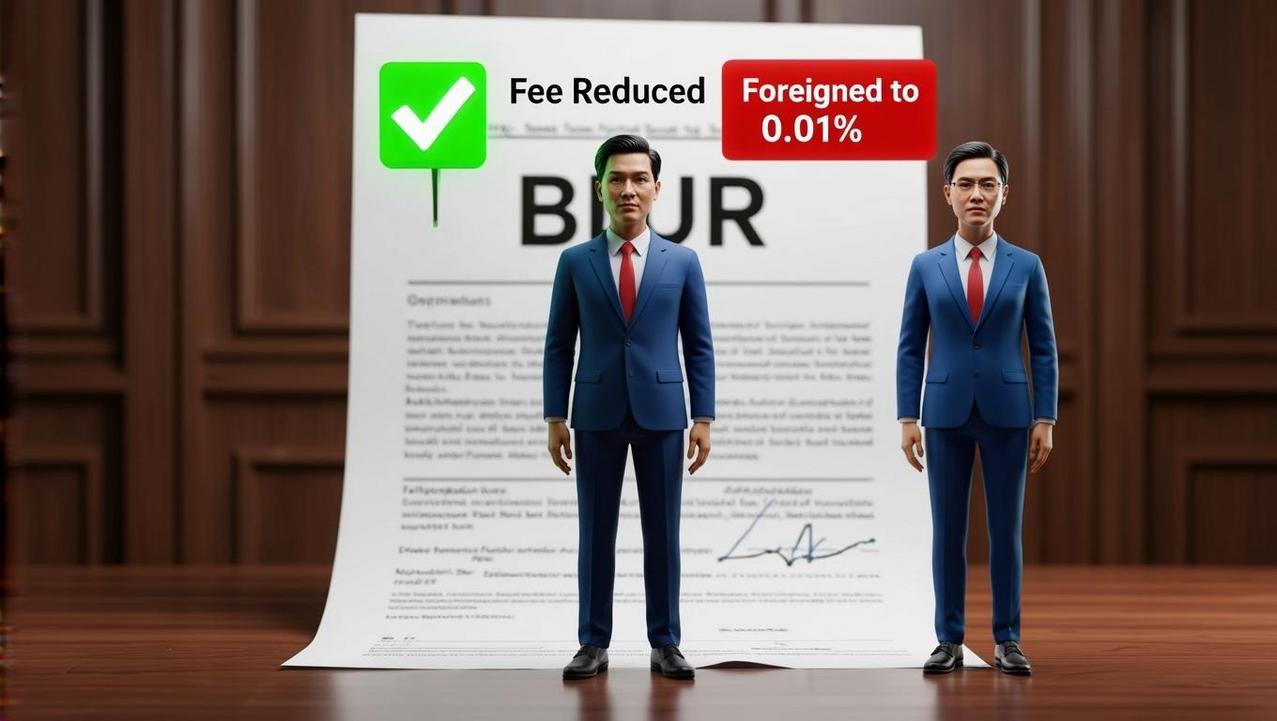
What are the current stimulus measures?
Thailand’s government has implemented property market stimulus measures reducing the transfer fee to 0.01% for qualifying transactions. These measures aim to boost domestic property sales and stimulate economic activity in the real estate sector.
The critical eligibility rules: value caps and nationality
The reduced transfer fee rates apply exclusively to properties valued below specific thresholds—typically 3 million THB for condominiums and 5 million THB for landed properties, though these figures are subject to periodic adjustment.
Critical Point for Foreign Buyers: These stimulus measures are generally applicable only to Thai nationals. Foreign buyers are typically excluded from the reduced transfer fee rates, regardless of the property value or transaction circumstances. This restriction represents a significant point of confusion that many foreign buyers discover only at the transfer stage, highlighting the importance of accurate pre-purchase budgeting based on standard rates.
Putting it all together: real-world calculation scenarios

Understanding these costs requires examining practical applications across different transaction types and values. The following scenarios demonstrate how various factors influence the total transfer costs.
Scenario 1: foreigner buying a 10m thb condo (seller owned for 3 years)
| Cost Component | Calculation | Amount (THB) |
|---|---|---|
| Property Value | Given | 10,000,000 |
| Transfer Fee (Buyer’s Share) | 1% | 100,000 |
| Transfer Fee (Seller’s Share) | 1% | 100,000 |
| SBT (Seller) | 3.3% | 330,000 |
| Withholding Tax (Seller) | ~2.5% (estimated) | 250,000 |
| Total Buyer Cost | 100,000 | |
| Total Seller Cost | 680,000 |
Scenario 2: buying a 30m thb Koh Samui villa (seller owned for 7 years)
Koh Samui’s luxury villa market exemplifies Thailand’s premium property sector, where the island’s stunning beaches and world-class amenities attract discerning international buyers seeking both lifestyle and investment value.
| Cost Component | Calculation | Amount (THB) |
|---|---|---|
| Property Value | Given | 30,000,000 |
| Transfer Fee (Buyer’s Share) | 1% | 300,000 |
| Transfer Fee (Seller’s Share) | 1% | 300,000 |
| Stamp Duty (Seller) | 0.5% | 150,000 |
| Withholding Tax (Seller) | ~1.8% (estimated) | 540,000 |
| Total Buyer Cost | 300,000 | |
| Total Seller Cost | 990,000 |
The Koh Samui villa scenario demonstrates how longer ownership periods benefit sellers through both lower tax rates (Stamp Duty vs. SBT) and reduced withholding tax calculations, making the island’s luxury villas attractive for long-term investment strategies.
Frequently asked questions
Q1: How much are property transfer fees in Thailand?
In total, the mandatory government costs for a property transfer in Thailand typically range from 2.5% to over 6.3% of the property’s official appraised value, depending heavily on how long the seller has owned the property and the specific tax circumstances.
Q2: Who pays transfer fees in a Thailand property sale?
This is negotiable and should be defined in your contract. Commonly, the 2% transfer fee is split 50/50 between buyer and seller, while the seller is legally responsible for the Specific Business Tax (or Stamp Duty) and Withholding Tax.
Q3: What are the closing costs when buying a condo in Thailand?
As a buyer, your primary closing cost is usually your share of the 2% transfer fee, which is typically negotiated to 1% of the property’s value. You may also have legal fees for due diligence and attorney representation.
Q4: Can foreigners get the reduced property transfer fee in Thailand?
No, the government’s stimulus packages offering reduced transfer fees (e.g., 0.01%) are currently only applicable to Thai nationals meeting specific criteria including property value caps and citizenship requirements.
Q5: How can I manage the transfer if I’m not in Thailand?
You can use a Power of Attorney to have a legal representative handle the entire process at the Land Office on your behalf, ensuring compliance with all requirements while accommodating your international schedule.

On this page: The legal foundation: understanding the power of attorney in Thailand The international execution blueprint: your step-by-step authentication guide Your shield against risk: why appointing a lawyer is non-negotiable The final checks: required documents and costs for a remote transfer Show more Key takeaways for a secure remote closing Frequently asked questions about […]
Understanding property transfer costs and taxes is an important step when evaluating long-term options in Thailand. At the same time, many travelers and residents choose to experience different regions through private villa stays before committing to ownership. Forbes & Partners offers a curated gateway to luxury villas, allowing guests to explore locations, lifestyles, and standards across Thailand without long-term obligations.
Budgeting with confidence
The key to a smooth property transaction in Thailand lies in understanding and budgeting for all costs beyond the purchase price. Transfer fees, taxes, and government charges can represent a substantial additional expense that, when properly anticipated, becomes a manageable component of your property investment strategy.
By comprehensively understanding the roles of the Transfer Fee, SBT/Stamp Duty, and Withholding Tax—and by clearly negotiating payment responsibilities in your Sale and Purchase Agreement—both buyers and sellers can approach the final transfer with complete financial confidence and no unwelcome surprises.
The complexity of these calculations and the significant financial implications underscore the importance of professional guidance throughout the process. Need to calculate the exact costs for your villa purchase or sale? The specifics can be complex, particularly when factoring in individual tax circumstances and current market conditions. Let us connect you with a legal expert for a precise financial assessment to ensure there are no surprises at closing.
Contact Forbes & Partners Today

Forbes & Partners Editorial Team
The Forbes & Partners Editorial Team specializes in creating expert-driven insights on luxury villas, property investment, and vacation rentals in Thailand. Each article blends the efficiency of AI-assisted writing with the precision and experience of human specialists in Thailand’s luxury real estate market, ensuring readers receive reliable, up-to-date, and high-value information to guide their next investment or stay.