- Main Article: Phuket vs. Koh Samui: The Definitive 2025 Breakdown of Luxury Living Costs
- Related articles:
Which is a better investment for a luxury villa: Phuket or Koh Samui?
Quick Answer: Phuket is a better investment for capital preservation, offering a mature, stable market with predictable rental yields of 6-8%. In contrast, Koh Samui is better for higher growth, presenting an emerging market with significant capital appreciation potential (8-15% annually) and superior rental yields of up to 12%.
For investors deciding between Thailand's premier luxury villa markets, here is a summary of the key financial differences:
- Investment Profile: Phuket is a mature, blue-chip market focused on capital preservation, while Koh Samui is a high-growth market offering higher yield and appreciation potential.
- Rental Yields: Phuket offers stable net rental yields of 6-8%. Koh Samui can achieve superior yields, often reaching 10-12% for premium properties.
- Capital Appreciation: Phuket's market shows steady appreciation of 3-5% annually. Koh Samui has a higher growth forecast, with potential for 8-15% annual appreciation.
- Value for Money: A $5M investment typically buys a 4-5 bedroom villa in an established Phuket location, versus a larger 5-7 bedroom villa with more land and privacy in Koh Samui.
- Foreign Ownership: Investors can use a 90-year Leasehold for secure tenure or a Thai Limited Company structure for perpetual freehold ownership and greater control.

Investing beyond the postcard view: a strategic financial analysis for the discerning investor
For high-net-worth investors, the most critical question isn’t just ‘where to buy?’, but ‘where will my capital perform best?’. This article moves beyond lifestyle appeal to dissect the core financial metrics of Thailand’s two leading luxury markets.
While both Phuket and Koh Samui offer paradise, they represent fundamentally different investment theses—Phuket as a mature, stable market and Koh Samui as a high-growth, high-yield emerging opportunity. While our comprehensive guide on the Phuket vs. Koh Samui: The Definitive 2025 Breakdown of Luxury Living Costs covers the nuanced lifestyle expenses, this analysis focuses squarely on the investment mechanics and financial returns of their respective villa markets.

On this page: The verdict in numbers: a cost of living snapshot The ultimate 2025 investment guide: analyzing luxury villa prices Show more High-end property purchase: what your money buys Rental yields and market potential: stability vs. growth Budgeting for bliss: the real cost of a high-end daily lifestyle Show more Fine dining and entertainment […]
This is not another travel guide. This is a data-driven investment playbook for 2025, analyzing net ROI, capital appreciation, and risk-adjusted returns to guide your acquisition strategy. In a marketplace where multi-million dollar decisions are made on instinct rather than intelligence, we provide the analytical foundation that sophisticated investors demand.
The fundamental market dichotomy: analyzing price ceilings and property value
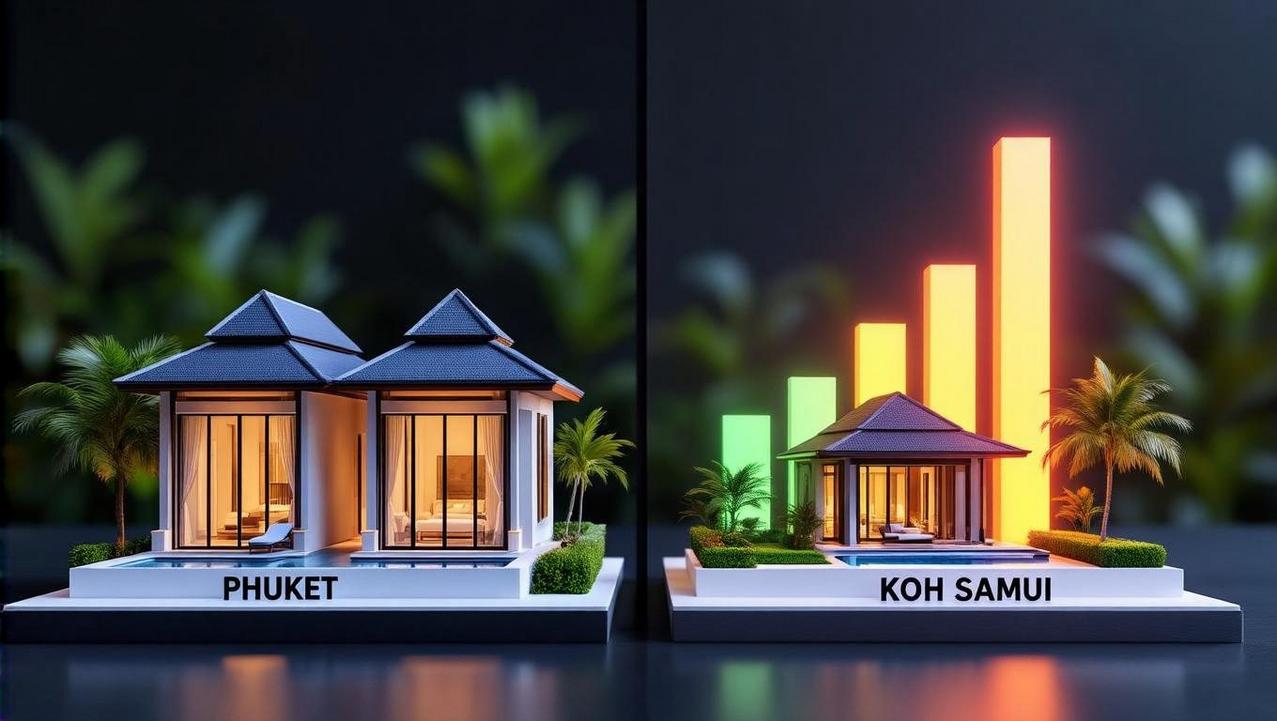
Phuket: the established blue-chip investment
Phuket represents Thailand’s most mature luxury real estate market, characterized by higher price points, a clear price ceiling of $20M+, and a history of stable, predictable growth. The island’s premium west coast locations—from Surin to Kamala and the established Laguna area—have attracted consistent international investment for over two decades.
The concentration of ultra-luxury branded residences sets Phuket apart as a blue-chip destination. Projects like Botanica Luxury Villas exemplify this maturity, offering turnkey investment opportunities within established resort ecosystems. According to the CBRE Thailand Real Estate Market Outlook 2025, Phuket’s market stability and international appeal continue to attract institutional investors seeking wealth preservation rather than aggressive growth.
Koh Samui: the high-growth, value-driven opportunity
In contrast, Koh Samui presents an emerging market with significant upside potential. The island’s current price ceiling sits around $8M for ultra-luxury properties, indicating substantial room for capital appreciation as the market matures. This differential represents a fundamental value proposition for growth-oriented investors.
The ‘value for space’ equation strongly favors Koh Samui, where investors consistently acquire larger land plots and more built-up space for equivalent capital outlay compared to Phuket. Infrastructure improvements and the ‘White Lotus effect’ have elevated the island’s luxury profile, while Koh Samui’s airport welcomes international flights, enhancing accessibility for discerning travelers.
Koh Samui villas offer unparalleled privacy and panoramic sea views due to the island’s unique topography and development regulations, creating exclusive enclaves that cannot be replicated in more developed markets.
Deconstructing the return on investment: a net-to-net comparison
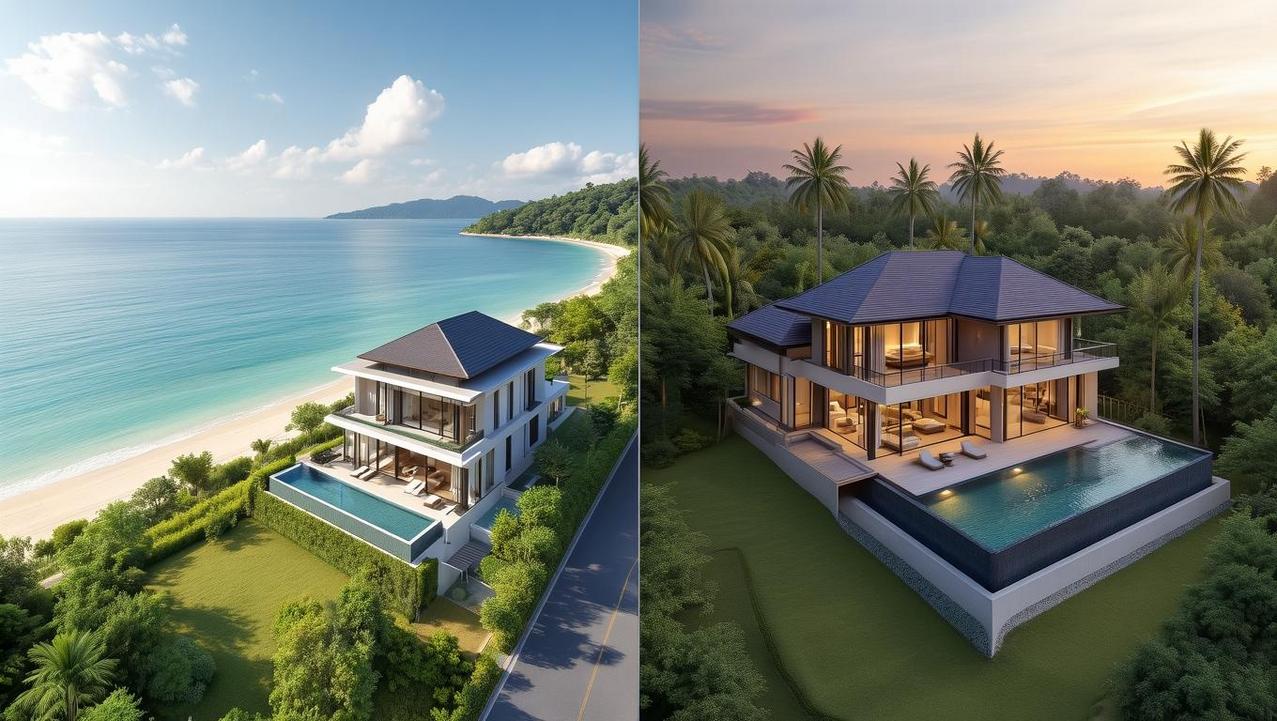
Our fiduciary responsibility to clients demands transparent, net calculations that move beyond gross marketing figures to reveal true investment performance. This analytical approach distinguishes sophisticated advisory services from generic property promotion.
Rental yields: comparing performance and seasonality
Phuket’s established tourism infrastructure supports consistent rental demand throughout an extended high season, typically generating stable yields of 6-8% for well-positioned properties. The island’s mature market offers predictable performance with lower volatility—ideal for risk-averse investors prioritizing steady income generation.
Koh Samui demonstrates superior yield potential, particularly for premium properties in prime locations. Our client data shows that well-managed villas in Phuket’s Laguna area average a 6-8% net rental yield, while select properties in Koh Samui’s Bophut Hills have achieved upwards of 10-12% during peak demand cycles. The island’s smaller luxury inventory creates scarcity value that commands premium rates.
Capital appreciation forecast for 2025 and beyond
Phuket’s mature market trajectory suggests steady, incremental appreciation averaging 3-5% annually—attractive for wealth preservation strategies. The JLL prediction for robust 2025 investment reinforces confidence in established markets like Phuket for long-term stability.
Koh Samui presents compelling capital growth potential, with new infrastructure projects and increasing international recognition driving double-digit appreciation in select submarkets. The Global Property Guide’s analysis supports projections of 8-15% annual growth for premium Samui properties through 2027.
Calculating the true net ROI: factoring in operational costs
Sophisticated investors require comprehensive cost analysis that includes:
- Property management fees (typically 15-25% of gross rental income)
- Marketing and distribution costs
- Maintenance and refurbishment reserves
- Luxury-specific utilities and staff salaries
- Professional legal and accounting services
Comparative cost of living data indicates that while both destinations command premium operational costs, Koh Samui’s smaller scale can result in more personalized, cost-effective management solutions.
The tangible returns: a deep-dive into what a $5m investment acquires

A $5m villa profile in Phuket
At the $5M threshold, Phuket delivers a contemporary 4-5 bedroom villa in established west coast locations such as Surin, Kamala, or within the prestigious Laguna complex. These properties typically feature direct oceanfront positioning or premium sea views, integration within managed estates offering shared amenities, and proximity to established fine dining and beach club infrastructure.
The investment profile emphasizes capital preservation through brand recognition, plug-and-play rental management within mature ecosystems, and predictable performance metrics based on historical data.
A $5m villa profile in Koh Samui
The same capital investment in Koh Samui typically secures a larger 5-7 bedroom villa with more expansive land plots in prime locations such as Bophut Hills, Chaweng Noi, or tranquil south-coast positions. These properties emphasize panoramic, elevated sea views with greater privacy and space, often featuring unique amenities like private spa facilities, home gyms, or cinema rooms.
The investment profile targets value-for-money in terms of size and amenities, higher yield potential through scarcity value, and significant capital appreciation upside as the market matures.
| Investment Comparison ($5M USD) | Phuket | Koh Samui |
|---|---|---|
| Typical Bedrooms | 4-5 | 5-7 |
| Land Size | 800-1,200 sqm | 1,200-2,000+ sqm |
| Location Character | Oceanfront/Premium sea view | Elevated panoramic views |
| Primary Advantage | Established ecosystem | Space and privacy |
| Investment Focus | Capital preservation | Growth and yield |
The legal framework for foreign ownership: mitigating risk and maximizing security
Understanding leasehold agreements
Foreign investors can acquire Thai property through leasehold structures offering 30+30+30 year terms—effectively 90 years of secure tenure when properly structured. This approach provides simpler setup procedures and lower initial legal costs, making it attractive for straightforward acquisitions.
However, investors must ensure comprehensive legal documentation by reputable law firms to protect renewal rights and property control throughout the lease term.
Utilizing a thai limited company for freehold ownership
The Thai Limited Company structure enables perpetual freehold ownership through majority Thai shareholding arrangements, while foreign investors maintain operational control via preference shares and directorship provisions. This sophisticated approach offers perpetual ownership with full control and enhanced asset liquidity compared to leasehold arrangements.
While requiring more complex initial setup and ongoing compliance obligations, this structure represents the gold standard for serious luxury property investors when properly implemented by experienced legal professionals.
| Ownership Structure | Leasehold | Thai Limited Company |
|---|---|---|
| Ownership Term | 90 years (renewable) | Perpetual |
| Setup Complexity | Simple | Moderate to complex |
| Ongoing Compliance | Minimal | Annual reporting required |
| Best For | Lifestyle buyers | Investment-focused buyers |
Future-proofing your investment: market trajectory and emerging trends for 2025
The rise of wellness and sustainable real estate
The global wellness real estate market is experiencing unprecedented growth, with Thailand positioned as a leading destination for luxury wellness-oriented properties. Phuket’s established wellness resort communities and integrated facilities command premium rental rates and attract affluent, health-conscious clientele seeking transformative experiences.
Koh Samui’s natural tranquility and focus on eco-friendly, nature-integrated villa designs align perfectly with sustainable luxury trends. These properties consistently achieve higher occupancy rates and command premium pricing from discerning guests prioritizing environmental responsibility.
Branded residences vs. independent villas: a strategic choice
Branded residences, more prevalent in Phuket’s mature market, offer turnkey investment solutions with professional management systems and established marketing channels. However, they typically involve higher management fees and operational restrictions that limit personal usage flexibility.
Independent luxury villas, particularly common in Koh Samui’s bespoke market, provide greater personalization opportunities and potential value creation through strategic improvements and unique positioning. This approach demands more active management but offers superior long-term value appreciation potential.
Frequently asked investment questions
Is buying property in Phuket a good investment?
Yes, buying property in Phuket is considered a good investment for those seeking stability, proven rental returns, and long-term capital preservation in a mature, world-class destination. Its strong infrastructure and global brand recognition provide a secure foundation for real estate assets.
What is the rental yield on Koh Samui?
The rental yield on Koh Samui can be quite attractive, often ranging from 6% to over 12% annually for luxury villas in prime locations. Yields are typically higher than in Phuket, reflecting the island’s strong demand for high-end vacation rentals and its value-for-money proposition.
Can foreigners buy property in Koh Samui?
Yes, foreigners can buy property in Koh Samui. While foreign nationals cannot own land directly, they can securely acquire villas through long-term leasehold agreements (up to 90 years) or by setting up a Thai Limited Company to own the property freehold.
What is the real estate trend in Thailand 2025?
The key real estate trend in Thailand for 2025 is a strong focus on wellness and sustainability, with continued high demand for luxury branded residences and a resurgence in international investment, particularly in premier destinations like Phuket and Koh Samui, as predicted by major consultancies like JLL and CBRE.
Which is better, Phuket or Koh Samui for families?
The better choice for families depends on priorities: Phuket offers a wider range of top-tier international schools, JCI-accredited hospitals, and amenities due to its more developed infrastructure. Koh Samui offers a more tranquil, community-focused, and nature-oriented lifestyle that many families find appealing.
Aligning your investment strategy with the right island
The optimal choice between Phuket and Koh Samui is not universal; it is deeply personal to an investor’s strategic objectives and risk tolerance. Our analysis reveals two distinct investment profiles, each offering compelling advantages for different investor types.
Choose Phuket for stable, blue-chip assets with predictable returns and a wealth preservation focus. This market suits conservative investors seeking established infrastructure, proven rental ecosystems, and steady capital appreciation within a mature international destination.
Choose Koh Samui for a strategy centered on higher rental yields, exceptional value for space, and significant capital appreciation potential. This emerging market appeals to growth-oriented investors comfortable with slightly higher risk in exchange for superior return potential.
The most successful investors we work with are those who first define their primary objective—be it yield, growth, or a hybrid approach—and then let that objective guide the location selection. Both islands offer exceptional opportunities, but only one will be perfectly aligned with your investment thesis and long-term wealth creation strategy.
Ready to make a smart investment in paradise? Contact our property specialists for a private consultation on opportunities in Phuket and Koh Samui.

Forbes & Partners Editorial Team
The Forbes & Partners Editorial Team specializes in creating expert-driven insights on luxury villas, property investment, and vacation rentals in Thailand. Each article blends the efficiency of AI-assisted writing with the precision and experience of human specialists in Thailand’s luxury real estate market, ensuring readers receive reliable, up-to-date, and high-value information to guide their next investment or stay.